Irish and English
Language
Irish is the first official language
Source
Country guide · Ireland
Unless you're an Irish, EU, EEA, Swiss or UK citizen, you'll usually need an employment permit to work in Ireland. The two main ones are the Critical Skills Employment Permit and the General Employment Permit.
Irish and English
Language
Irish is the first official language
SourceEuro
Currency
€, EUR
SourceDublin
Capital
SourceIST / GMT
Time zone
Irish Standard Time (UTC+1) in summer, GMT in winter
Source112 or 999
Emergency number
SourceType G
Plug
Three rectangular pins, 230 V
SourceCritical Skills Employment Permit
Main work route
Source€40,904 a year
Minimum salary
SourceLast checked 9 Nov 2026. Every figure links to its official source.
Find a specialistSee jobs in Ireland. You can also browse all visa sponsorship jobs or go back to the Global Sponsor Hub homepage.
Ireland roles
Each listing shows what the employer or agency offers: visa sponsorship, relocation support or remote work.
No live roles listed here right now.
See jobsAll regions lets you pick a place and see rent, jobs and the sectors in this guide.
Cyan is the region you picked. Navy is everywhere else.
Region
Engineering is 15.3% of jobs here, 1.23 times its share across Ireland.
Sector strength vs average for Ireland
Job links open all Ireland roles for now.
Bars show each sector's share of jobs here against its share across the country. Tech means information and communication, engineering means all industry, including manufacturing, energy and mining, finance means finance, insurance and real estate and hospitality means hotels, restaurants and cafes. Source: Central Statistics Office, average of July 2025 to June 2026.
| Region | Counties | Population, Apr 2026 | People in work |
|---|---|---|---|
| Border | Cavan, Donegal, Leitrim, Monaghan, Sligo | 447,600 | 212,300 |
| West | Galway, Mayo, Roscommon | 531,100 | 273,600 |
| Mid-West | Clare, Limerick, Tipperary | 543,000 | 274,100 |
| South-East | Carlow, Kilkenny, Waterford, Wexford | 485,400 | 236,100 |
| South-West | Cork, Kerry | 792,900 | 416,400 |
| Dublin | Dublin | 1,597,700 | 840,600 |
| Mid-East | Kildare, Louth, Meath, Wicklow | 788,400 | 403,100 |
| Midland | Laois, Longford, Offaly, Westmeath | 339,400 | 166,900 |
| Region | People in work | Tech | Healthcare | Engineering | Finance | Hospitality |
|---|---|---|---|---|---|---|
| Border | 212,325 | n/a | 16.5% (1.19×) | 15.3% (1.23×) | 2.9% (0.54×) | 6.6% (1.01×) |
| West | 273,625 | 3.5% (0.57×) | 14.4% (1.04×) | 16.8% (1.34×) | n/a | 6.5% (1.01×) |
| Mid-West | 274,075 | 3.7% (0.61×) | 13.7% (0.99×) | 17.5% (1.40×) | 3.9% (0.74×) | 5.4% (0.83×) |
| South-East | 236,050 | n/a | 14.9% (1.08×) | 13.5% (1.08×) | 3.6% (0.68×) | 8.0% (1.24×) |
| South-West | 416,425 | 4.7% (0.77×) | 12.4% (0.90×) | 15.8% (1.26×) | 2.9% (0.54×) | 8.3% (1.29×) |
| Dublin | 840,625 | 11.1% (1.81×) | 13.8% (1.00×) | 7.4% (0.59×) | 9.0% (1.70×) | 6.0% (0.92×) |
| Mid-East | 403,075 | 5.5% (0.89×) | 12.9% (0.94×) | 11.3% (0.90×) | 5.8% (1.09×) | 5.3% (0.81×) |
| Midland | 166,875 | n/a | 13.8% (1.00×) | 13.0% (1.04×) | n/a | 6.6% (1.02×) |
| Ireland | 2,823,025 | 6.2% | 13.8% | 12.5% | 5.3% | 6.5% |
Central Statistics Office: QLF56 Persons aged 15-89 years in Employment by Sex, NACE Rev 2.1 Economic Sector, NUTS 3 Region and Quarter (Labour Force Survey). Average of July 2025 to June 2026. Employed people by the region they live in. Industry codes: NACE Rev. 2.1. n/a means the source does not publish that figure, usually because the number is too small. View the source
Visa and sponsorship key dates for Ireland
Climate
Average hours of sunshine a day, 1991 to 2020
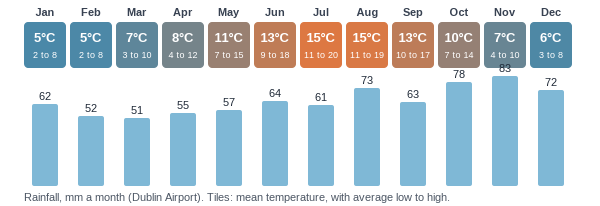
Source: Met Eireann 1991-2020 normals
Pack for the seasons that matter in Ireland. Check local forecasts before you travel, and use the city notes in this guide for sunshine and rainfall patterns.
Cities
Pay, rent and the share of pay that rent takes.
€50,472 a year (€4,206 a month)Pay
€2,159 a monthRent
51%Rent share
€48,328 a yearPay
€1,701 a monthRent
42%Rent share
€46,000 a yearPay
€1,850 a monthRent
48%Rent share
€46,426 a yearPay
€1,709 a monthRent
44%Rent share
€33,578 a year (€2,798.13 a month)Pay
€1,500.00 a monthRent
54%Rent share
South east's main city; pharma and medtech manufacturing. Numbeo sample is small, so treat figures as rough.
See jobs in WaterfordCrowd-sourced estimates for budgeting; official city-card figures take priority where available.
Price your household with the tools below
Numbeo, accessed 13 October 2026
Tools
Revenue shows how PAYE and the Universal Social Charge are worked out. Your tax credit certificate sets the band and the credits.
Rent a month in Dublin
€2,159 a month
Income tax, single: 20% on the first €44,000; 40% on the balance (married, one income: €53,000) (Revenue)
USC: 0.5% on first €12,012; 2% on next €16,688; 3% on next €41,344; 8% on the balance (Revenue)
Employee PRSI (Class A): 4.2% to 30 September 2026, 4.35% from 1 October 2026, on all earnings over €352 a week; tapered credit between €352.01 and €424 (DSP)
USC exemption and reduced rate: No USC if total income is €13,000 or less. Full medical card holders with income of €60,000 or less pay 0.5% on the first €12,012 and 2% on the rest (Revenue, Standard rates and Reduced rates of USC)
PRSI credit taper: Maximum €12 a week at €352.01, reduced by one-sixth of earnings above €352.01, reaching zero at €424 (gov.ie, PRSI Class A rates; Citizens Information)
Revenue shows how PAYE and the Universal Social Charge are worked out. Your tax credit certificate sets the band and the credits.
See how Revenue calculates taxStep 1 of 2
A route to read about, not a decision on your application. Figures are the ones in this guide.
Compare pay and rent for the cities already listed in this guide.
Rent a month in Dublin
€2,159 a month
€40,904 a year
Listed occupation with a relevant degree: €40,904 a year or more, from 1 March 2026. The threshold is €36,848 where the qualification was received in the 12 months before the application, and over €68,911 for other eligible occupations that are not on the ineligible list.
Since 1 March 2026 they generally start at €40,904 and €36,605 a year. Rent varies widely, with Dublin the most expensive by far.
€36,605
€36,605 generally; €32,691 (hourly €16.12) for horticulture worker, meat processor operative, health care assistant and home support worker (SOC 6145); and €34,009 where the applicant has a relevant degree from an Irish third-level college in the previous 12 months. A Labour Market Needs Test is required in most cases.
Since 1 March 2026 they generally start at €40,904 and €36,605 a year. Rent varies widely, with Dublin the most expensive by far.
€49,523 a year
€49,523 a year for senior management and key personnel, and €36,605 for personnel on a training programme.
SourceRoute
After 9 months in the first permit job (Employment Permits Act 2024).
SourceRoute
Dependant/Partner/Spouse, Seasonal, Reactivation, Sport and Cultural. DETE permit types page.
SourceRoute
For non-EEA graduates of Irish institutions.
SourceRoute
For citizens of programme countries, run by the Department of Foreign Affairs. 2026 programme countries: Andorra, Argentina, Australia, Canada, Chile, Hong Kong, Japan, New Zealand, South Korea, Taiwan and the United States.
SourceThe Employment Permits Portal was taken offline after a security incident (notice 29 October 2026). A 2 November 2026 notice said it would not return on 3 November and would reopen only after security measures, testing and independent assurance. Applications received before the outage are still being assessed and decisions are issuing. Alternative arrangements for new applications were still being finalised in that notice. A 5 November 2026 update covered whose names were downloaded. It did not announce a reopen date, and no later official reopen date was on the notices page on 9 November 2026.
Separately, DETE said on 4 November 2026 that the General Employment Permit quota for furniture makers and other craft woodworkers (S.I. 444/2024) is filled and pending applications will be rejected.
Official sourceLife in Ireland
The rental market, soft rain and long summer evenings, the pub and GAA club as social spaces, bilingual signs, small-talk culture.
Euro (€, EUR)
112 or 999
Type G (three rectangular pins), 230 V
Irish and English. Irish is the first official language; English is the second. 40% of people said they can speak Irish (Census 2022)
Irish Standard Time (UTC+1) in summer, GMT in winter
Spouses and de facto partners of Critical Skills Employment Permit holders can apply for Stamp 1G permission and work without a separate employment permit. See Immigration Service Delivery.
Official sourcePrimary and post-primary education in state-funded schools is free; schooling is compulsory from 6 to 16.
Official sourceA monthly payment for children under 16 (or under 18 in full-time education); residence rules apply.
Official sourceThe National Childcare Scheme helps with registered childcare costs.
Official sourceLittle-known facts
40%
Vs 71,968 40% of people said they can speak Irish, but 71,968 speak it every day outside school
€2,335
Was the average monthly rent for new tenancies in County Dublin in Q1 2026, the highest county figure
1.81
Dublin's share of jobs in tech is 1.81 times Ireland's
1,239
Vs 773 mm Cork Airport gets about 60% more rain a year than Dublin Airport (1991 to 2020)
9 months
Employment permit holders can move to a new employer after 9 months
Timeline
Employment permit, entry visa if needed, arrival, register with immigration (IRP card), PPS number, bank, GP, housing, schools
Passport, permit, degree certificates, references, prescriptions
Non-EEA nationals staying more than 90 days register with Immigration Service Delivery.
Needed for work, tax and public services.
Avoids emergency tax on your first payslips.
GP visits are usually paid unless you hold a medical or GP visit card.
Banks ask for photo ID and proof of address.
Never pay a deposit for a property you haven't seen or for a landlord you can't verify. Employers can't charge you for the permit application or recover its costs (Employment Permits Act 2024, section 55). Check advisers carefully and report fraud to An Garda Síochána. Garda advice on rental fraud.
Yes. Employment permits are tied to a job offer from an Irish employer, and either the employer or the employee can apply. For your case, talk to a specialist.
Critical Skills covers listed, mostly degree-level occupations from €40,904 and has no Labour Market Needs Test. The General permit covers most other eligible jobs from €36,605 and usually needs the job advertised first.
After 9 months with your first permit employer, you can apply for a new permit with a new employer, within limits on occupation type.
No. DETE excludes bonuses from annual remuneration.
Public hospital care is available, but most people pay for GP visits unless they hold a medical card or GP visit card. Many people take private health insurance.
No. Each listing shows the support the employer or agency has stated, such as visa sponsorship or relocation support. Confirm it with the employer before you apply.
Checked against official sources. Need help with your own move? Find a specialist.
Create your free profile and choose whether employers and agencies can find you.
Job alerts
Join over 4,000 job seekers and growing daily.
Specialists
Visa, housing, tax and settling in. Look through listings, or ask one to get in touch.